Transition of Image and Sound: A transition is a action in film which refers to the shift from frame to frame. It is usually tried to be subtle as possible as not to attract the viewers attention away form the content of the piece.
To enhance the feeling of continuity, directors and editors try and place both a shots image and sound correctly to create a streamlined effect for the viewer.
Also the use of this technique can be used to tell the viewer that you are now viewing a shot which takes place in somewhere else.
Continuity and Non-Continuity Systems: This refers to the process in film and television that ensure that the details are consistent through the narrative. For example, the continuity person will make sure that the actor's hairstyle does not change from shot to shot and ensures that lighting is the same from take to take.
Through out this example, it shows continuous scenes of continuity from different camera angles and also good transition of image and sound to make sure the audience knows where they are at each shot. (The fact that this is a British drama is the only reason i'm using this, it pains me that this is on my blog.)
Cutting: This term in film editing comes from the literal cutting of the film that is part of film making. This has lead to the development of terms like "rough cut" and "first cut". This is a key part of film making and it is very rare to find a piece of film that goes longer than a number of minutes without a cut to another shot.
Eyeline Match: This refers to the matching of shots in film so that the gaze of a character is seen to match to that of another character or to construct the consistent gaze of a character at a landscape or object. The shots are then edited together to create the sensation of continuity in the look.
I.e. If one of the shots shows a character looking out, the next will often show what he or she is looking as from the angle and level that would suggest that the shot is from their eye-line.
In this example we see that the director uses eyeline matches to show the characters looking at eachother and the camera operator even gets the angle at which the character would view the other person at also very well. (Yeo, 'mon the skins.)
Graphic Match: This refers to the two camera shots distinct elements match and thus this builds a sense of continuity of action between two objects, which may be just similar in shape, colour or usage etc.
Action Match: This refers to a major continuity tool when editors use to mach movements which other movements to create a seamlessness between them and so the viewer is not aware to notices that they are interrupted movements which time has elapsed.
This is done by careful fame by frame matching, e.g., using footsteps or sound etc.
Tuesday, 30 September 2008

Thursday, 25 September 2008
Editing Techniques
Parallel Editing: Parallel editing, or crosscutting, a cinematic convention in which two or more concurrent scenes are interwoven with each other. It can be used to show the differences between two separate experiences, e.g. two separate peoples journey to the same party.

Cross Cutting: This is an editing technique used in films to establish continuity. In a cross-cut, the camera will cut away from one action to another action. Because the shots occur one after another, cross-cutting is used to suggest simultaneity of action.
Jump cut: This is a cut in editing where the middle section of a continuous shot is removed, and the beginning and end of the shot are then joined together. The technique breaks continuity in time and produces a startling effect.

Shot/Reverse Shot: This is a film technique wherein one character is shown looking (often off-screen) at another character, and then the other character is shown looking "back" at the first character. Since the characters are shown facing in opposite directions, the viewer assumes that they are looking at each other.
This is a British example of shot and reverse shots used to create a conversation like atmosphere to the viewer from one of my favourite shows skins (1:00- onwards).

Cross Cutting: This is an editing technique used in films to establish continuity. In a cross-cut, the camera will cut away from one action to another action. Because the shots occur one after another, cross-cutting is used to suggest simultaneity of action.
Jump cut: This is a cut in editing where the middle section of a continuous shot is removed, and the beginning and end of the shot are then joined together. The technique breaks continuity in time and produces a startling effect.

Shot/Reverse Shot: This is a film technique wherein one character is shown looking (often off-screen) at another character, and then the other character is shown looking "back" at the first character. Since the characters are shown facing in opposite directions, the viewer assumes that they are looking at each other.
This is a British example of shot and reverse shots used to create a conversation like atmosphere to the viewer from one of my favourite shows skins (1:00- onwards).
Sunday, 21 September 2008
More Shot Types
Hand Held: Hand-held camera or hand-held shooting is a film and video technique in which a camera is literally held in the camera-operator's hands--as opposed to being placed on a tripod. The result is an image that is perceptibly shakier than that of a tripod-mounted camera.
 This example is taken from the movie Cloverfield, which was made in its entirety using hand held cameras to give a POV type of feel.
Zoom: Zooming means altering the focal length of the lens to give the illusion of moving closer to or further away from the action. Can establish sudden realisation.
Reverse Zoom: This is when the establishing shot is one that is closer to the object and as you zoom out you get a fuller picture. Can be used to establish isolation.
(since everyone has at least one lego shot on their blog, thought i might join in :L)
Rule of Thirds: This is a concept in video and film production in which the frame is divided into into nine imaginary sections. This creates reference points which act as guides for framing the image. Points (or lines) of interest should occur at 1/3 or 2/3 of the way up (or across) the frame, rather than in the centre. In most "people shots", the main line of interest is the line going through the eyes. In this shot, the eyes are placed approximately 1/3 of the way down the frame.
Deep and Shallow Focus: This is a technique incorporating depth-of-field. Depth-of-field is the front-to-back range of focus in an image i.e. how much of it appears sharp and clear. In deep focus the foreground, middle-ground and background are all in focus.
The opposite of deep focus is shallow focus, in which only one plane of the image is in focus.
Deep Focus Picture

Shallow Focus Picture

Focus Pulls: The focus pull is a creative camera technique in which you change focus during a shot. Usually this means adjusting the focus from one subject to another. See below (0.11-1.10).
 This example is taken from the movie Cloverfield, which was made in its entirety using hand held cameras to give a POV type of feel.
Zoom: Zooming means altering the focal length of the lens to give the illusion of moving closer to or further away from the action. Can establish sudden realisation.
Reverse Zoom: This is when the establishing shot is one that is closer to the object and as you zoom out you get a fuller picture. Can be used to establish isolation.
(since everyone has at least one lego shot on their blog, thought i might join in :L)
Rule of Thirds: This is a concept in video and film production in which the frame is divided into into nine imaginary sections. This creates reference points which act as guides for framing the image.
 Points (or lines) of interest should occur at 1/3 or 2/3 of the way up (or across) the frame, rather than in the centre. In most "people shots", the main line of interest is the line going through the eyes. In this shot, the eyes are placed approximately 1/3 of the way down the frame.
Deep and Shallow Focus: This is a technique incorporating depth-of-field. Depth-of-field is the front-to-back range of focus in an image i.e. how much of it appears sharp and clear. In deep focus the foreground, middle-ground and background are all in focus.
The opposite of deep focus is shallow focus, in which only one plane of the image is in focus.
Deep Focus Picture

Shallow Focus Picture

Focus Pulls: The focus pull is a creative camera technique in which you change focus during a shot. Usually this means adjusting the focus from one subject to another. See below (0.11-1.10).
Saturday, 20 September 2008
Shot Types
Pan: A pan is a horizontal camera movement in which the camera moves left and right about a central axis.
 Panning is also combined with zooming in or out on a single subject, leaving the subject in the same portion of the frame, to emphasize or de-emphasize the subject respectively. This is a very popular shot and would be hard to find a piece of film thats did not have at least one pan shot.
Tilt: A tilt is a vertical camera movement in which the camera points up or down from a stationary location.
 Tilting is less common than panning as it is the way humans work — we look left and right more often than we look up and down. Often used for establishing characters, for example, a new character or a tall building.
Track: Tracking is often defined as movement parallel to the action, or at least at a constant distance. Usually the camera is mounted on a cart which travels along tracks.
This is a famous tracking shot taken from the movie Goodfellas, this is far longer than what the average tracking shot would be.
Dolly: In many circles a dolly shot is also known as a tracking shot. However, dolly is defined as the in-and-out movement (i.e. closer/further away from the subject), while tracking means side-to-side movement.
This is an example of a dolly shot (1.50-4.37) taken from the movie panic room. You can see the similarities between the tracking shot and the dolly shot and how easily they can be taken for one another.
Crane: A crane shot, is basically, a shot taken by a camera on a crane. Most cranes accommodate both the camera and an operator, but some can be operated by remote control.
 The most obvious uses are to view the actors from above or to move up and away from them, a common way of ending a movie. Some filmmakers like to have the camera on a boom arm just to make it easier to move around between ordinary set-ups.
Steadicam: This is a technique which mechanically isolates the operator's movement from the camera, allowing a very smooth shot even when the operator is moving quickly over an uneven surface.
 This is a popular shot that allows the camera man to get better, clearer shots, without compromising the scene, for example, in a chase scene.
 Panning is also combined with zooming in or out on a single subject, leaving the subject in the same portion of the frame, to emphasize or de-emphasize the subject respectively. This is a very popular shot and would be hard to find a piece of film thats did not have at least one pan shot.
Tilt: A tilt is a vertical camera movement in which the camera points up or down from a stationary location.
 Tilting is less common than panning as it is the way humans work — we look left and right more often than we look up and down. Often used for establishing characters, for example, a new character or a tall building.
Track: Tracking is often defined as movement parallel to the action, or at least at a constant distance. Usually the camera is mounted on a cart which travels along tracks.
This is a famous tracking shot taken from the movie Goodfellas, this is far longer than what the average tracking shot would be.
Dolly: In many circles a dolly shot is also known as a tracking shot. However, dolly is defined as the in-and-out movement (i.e. closer/further away from the subject), while tracking means side-to-side movement.
This is an example of a dolly shot (1.50-4.37) taken from the movie panic room. You can see the similarities between the tracking shot and the dolly shot and how easily they can be taken for one another.
Crane: A crane shot, is basically, a shot taken by a camera on a crane. Most cranes accommodate both the camera and an operator, but some can be operated by remote control.
 The most obvious uses are to view the actors from above or to move up and away from them, a common way of ending a movie. Some filmmakers like to have the camera on a boom arm just to make it easier to move around between ordinary set-ups.
Steadicam: This is a technique which mechanically isolates the operator's movement from the camera, allowing a very smooth shot even when the operator is moving quickly over an uneven surface.
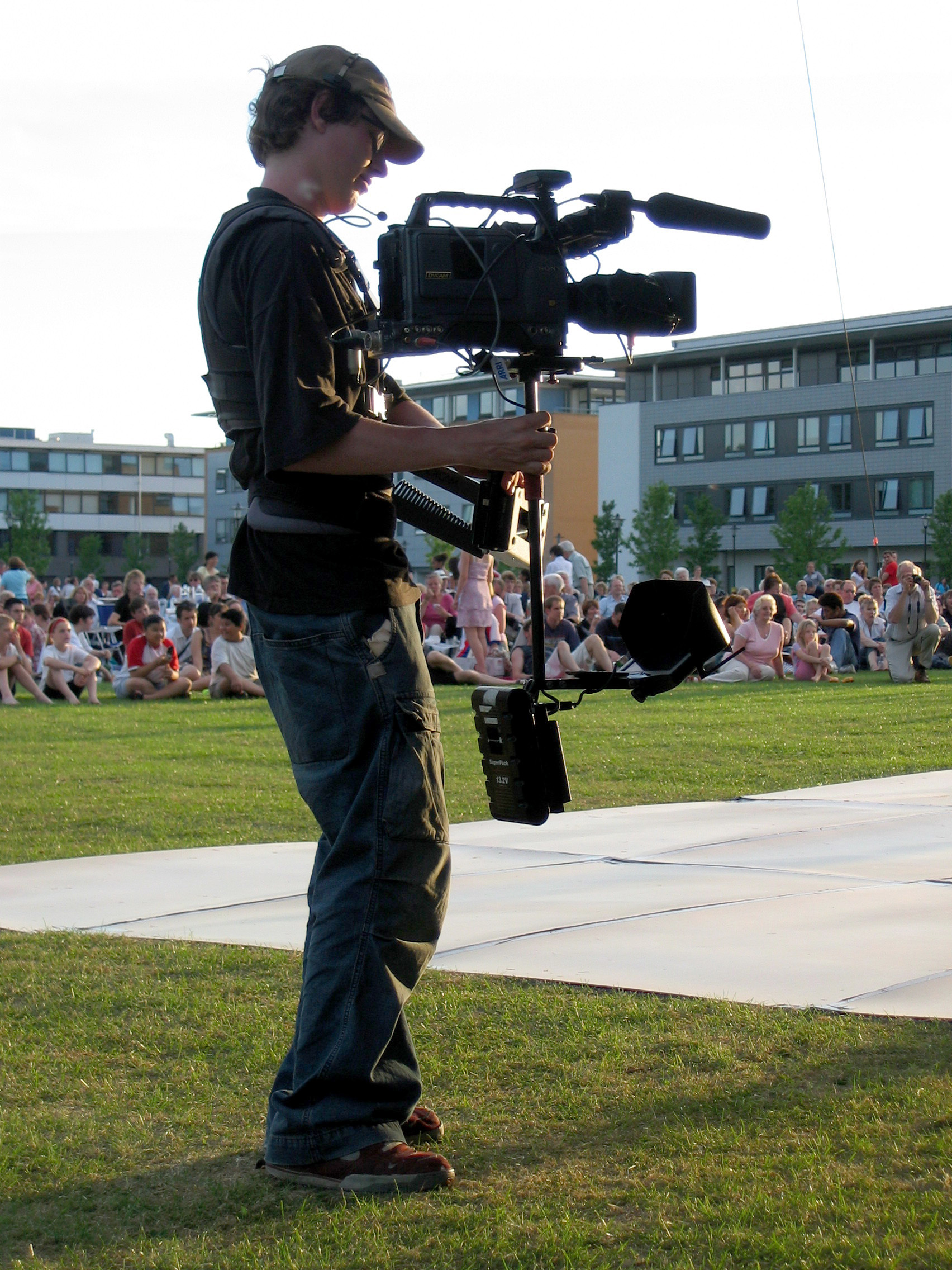 This is a popular shot that allows the camera man to get better, clearer shots, without compromising the scene, for example, in a chase scene.
Wednesday, 17 September 2008
Monday, 15 September 2008
How I Consume My Music.
I have been asked to write an essay to how i obtain, consume and handle my music. To put it simply, i love music. However, the bands that i love, wouldn't agree to the methods at with i obtain their product.
As many of people nowadays, i use peer-to-peer file sharing clients to get my music, such as LimeWire. Thanks to this and other forum sites i haven't bought a single track for 2 years. The last album i bought was Paolo Nutini's, These Streets.
The only reason i would buy music would be if it was a band that i knew needed my support, like Paolo Nutini. I had heard early demos and really enjoyed them, and of course when they got signed and their album came out, i decided that they where worth the £10.
I share my music through music forums and to my friends via sending them a song on msn or burning a CD for them. I try and give back to the bands as much as i can (...without buying their tracks) by going to see them in concert. Currently i have bought tickets to see 4 bands in November alone.
I believe that artists should receive money for their work but as it stands I'm torn. Torn between being a fan of the artist and a broke teen who loves music. I don't want to see my favorite bands going bankrupt because everyone is downloading their new album, but i also want to have that same new album as soon as, and in most cases before it's released, and the only way for me to get it at the moment it, is to illegally download it.
I don't believe that the musicians, managers, record labels or fans will be happy until there is a fundamental change in the way we obtain, consume and handle our music.

As many of people nowadays, i use peer-to-peer file sharing clients to get my music, such as LimeWire. Thanks to this and other forum sites i haven't bought a single track for 2 years. The last album i bought was Paolo Nutini's, These Streets.
The only reason i would buy music would be if it was a band that i knew needed my support, like Paolo Nutini. I had heard early demos and really enjoyed them, and of course when they got signed and their album came out, i decided that they where worth the £10.
I share my music through music forums and to my friends via sending them a song on msn or burning a CD for them. I try and give back to the bands as much as i can (...without buying their tracks) by going to see them in concert. Currently i have bought tickets to see 4 bands in November alone.
I believe that artists should receive money for their work but as it stands I'm torn. Torn between being a fan of the artist and a broke teen who loves music. I don't want to see my favorite bands going bankrupt because everyone is downloading their new album, but i also want to have that same new album as soon as, and in most cases before it's released, and the only way for me to get it at the moment it, is to illegally download it.
I don't believe that the musicians, managers, record labels or fans will be happy until there is a fundamental change in the way we obtain, consume and handle our music.

Saturday, 13 September 2008
High Angles, Low Angles and Canted Angles
High Angles: A high angle shows the subject from above, i.e. the camera is angled down towards the subject. This has the effect of diminishing the subject, making them appear less powerful, less significant or even submissive.
Low Angles: This shows the subject from below, giving them the impression of being more powerful or dominant.
Canted Angles: Sometimes the camera is tilted to suggest imbalance, transition and instability. This technique is used to suggest POV shots (a hand held camera is often used for this).
High Angle Picture

Low Angle Picture

Canted Angle Picture

Low Angles: This shows the subject from below, giving them the impression of being more powerful or dominant.
Canted Angles: Sometimes the camera is tilted to suggest imbalance, transition and instability. This technique is used to suggest POV shots (a hand held camera is often used for this).
High Angle Picture

Low Angle Picture

Canted Angle Picture

Point of View Shots and Over the Shoulder Shot
Point of View Shot: (also known as POV shot or a subjective camera) This type of shot is used to show a view from the subject's perspective. Usually established by being positioned between a shot of a character looking at something, and a shot showing the character's reaction so the audience is aware that it is a POV shot.
Over the Shoulder Shot: This type of shot is taken from behind a person at the subject, cutting off the frame just behind the ear. The person facing the subject should occupy about 1/3 of the frame.This shot helps to establish the positions of each person, and get the feel of looking at one person from the other's point of view.
Point of View Picture
 This point of view shot took place just after an establishing shot of a character "Locke" looking at the television at the video being played, which tells the audience that this is what john is currently watching. This allows the director to have the audience more engaged at what is being shown/ what the character is looking at.
Over the Shoulder Picture
 This shot was used to connect the audience to the characters and the events going on around/between the characters. This shot, I felt, was used to great effect as it also showed the expressions on the characters face which may have been lost it it was taken from a medium shot.
Over the Shoulder Shot: This type of shot is taken from behind a person at the subject, cutting off the frame just behind the ear. The person facing the subject should occupy about 1/3 of the frame.This shot helps to establish the positions of each person, and get the feel of looking at one person from the other's point of view.
Point of View Picture
 This point of view shot took place just after an establishing shot of a character "Locke" looking at the television at the video being played, which tells the audience that this is what john is currently watching. This allows the director to have the audience more engaged at what is being shown/ what the character is looking at.
Over the Shoulder Picture
 This shot was used to connect the audience to the characters and the events going on around/between the characters. This shot, I felt, was used to great effect as it also showed the expressions on the characters face which may have been lost it it was taken from a medium shot.
Two Shots and Aerial Shots
Two Shot: This type of shot encompasses a view of two people. The subjects do not have to be next to each other, and there are many common two-shots which have one subject in the foreground and the other subject in the background. Often used in interviews, or when two presenters are hosting a show.
Aerial Shot: This is simply a shot taken from the air. Aerial shots are usually done with a crane or with a camera attached to a special helicopter to view large landscapes. Often used in car chases or used to make the character seem insignificant or vulnerable.
Two Shot Picture

As we can see from the picture above that in this particular two shot that, as the definition explained, one subject is in the foreground and the other subject in the background. This is a good shot for conversations and interactions between the characters.
Aerial Shot Picture

This is an example of another way an aerial shot can be used, compared to the examples given in the definition. This was used to give the audience a feeling of helplessness and detachment from the people on the ship, just as the characters felt when they saw this happen from the helicopter.
Aerial Shot: This is simply a shot taken from the air. Aerial shots are usually done with a crane or with a camera attached to a special helicopter to view large landscapes. Often used in car chases or used to make the character seem insignificant or vulnerable.
Two Shot Picture

As we can see from the picture above that in this particular two shot that, as the definition explained, one subject is in the foreground and the other subject in the background. This is a good shot for conversations and interactions between the characters.
Aerial Shot Picture

This is an example of another way an aerial shot can be used, compared to the examples given in the definition. This was used to give the audience a feeling of helplessness and detachment from the people on the ship, just as the characters felt when they saw this happen from the helicopter.
Tuesday, 9 September 2008
Medium Shots and Close up Shots
Medium Shot: This is a shot where the subject and background share equal dominance in the picture. A medium shot of an individual will take in the body from the knees or waist up.
Close Up: This is a shot in which the subject is tightly framed and shown at a relatively large scale i.e. a very close shot of a person or an object.
Medium Shot Picture
 The Medium Shot is a good framing for conversation scenes (like the one seen above) between characters, especially if hand movements are part of the performance.
Close Up Picture
 Close ups (example seen above) of characters are a good way to engaging the audience into the character emotionally, such as in this seen, when the director used this dramatic close up to show the detached feelings of Ben (character above) to the character he was in the scene to show a side of Ben's character to the audience.
Medium and Close Up Video
In this clip, the audience is immediately engaged in the character as the director uses a number of close up shots to get across the tense feeling in the room (from 0:08-0:27). Later in the video we see the director begin to use medium shots and close ups for discussion between the characters (from 0:44-1:54).
Close Up: This is a shot in which the subject is tightly framed and shown at a relatively large scale i.e. a very close shot of a person or an object.
Medium Shot Picture
 The Medium Shot is a good framing for conversation scenes (like the one seen above) between characters, especially if hand movements are part of the performance.
Close Up Picture
 Close ups (example seen above) of characters are a good way to engaging the audience into the character emotionally, such as in this seen, when the director used this dramatic close up to show the detached feelings of Ben (character above) to the character he was in the scene to show a side of Ben's character to the audience.
Medium and Close Up Video
In this clip, the audience is immediately engaged in the character as the director uses a number of close up shots to get across the tense feeling in the room (from 0:08-0:27). Later in the video we see the director begin to use medium shots and close ups for discussion between the characters (from 0:44-1:54).
Monday, 8 September 2008
Long Shots and Extreme Long Shots
Long Shot: In film a shot taken from a distance that is used to convey a sense if space or to locate action in a specific place.
Extreme Long Shots: (aka the Wide Shot or Establishing Shot) The shot or sequence of shots in film or television that establishes a situation or location. It locates the initial meaning of th narrative.
I was asked to find evidence of both a long shot and an extreme long shot. I first had to find out what these terms ment (definitions seen above.)
I decided to take an example from my favorite show, Lost.
Long Shot Picture

This shot was used to get across to the audience the environment that the character are in and how many of the characters are effected in this scene.
Extreme Long Shot Picture

This shot was used to discover the small piece of civilization that "the others" have within a jungle that to the other main characters seems very untamed. Up until this point of the story the audience was led to believe that this scene took place off island.
Extreme Long Shots: (aka the Wide Shot or Establishing Shot) The shot or sequence of shots in film or television that establishes a situation or location. It locates the initial meaning of th narrative.
I was asked to find evidence of both a long shot and an extreme long shot. I first had to find out what these terms ment (definitions seen above.)
I decided to take an example from my favorite show, Lost.
Long Shot Picture

This shot was used to get across to the audience the environment that the character are in and how many of the characters are effected in this scene.
Extreme Long Shot Picture

This shot was used to discover the small piece of civilization that "the others" have within a jungle that to the other main characters seems very untamed. Up until this point of the story the audience was led to believe that this scene took place off island.
Subscribe to:
Comments (Atom)


