Tuesday, 2 December 2008

Spooks Analysis

From the extract that we have been shown there are some clear defining moments throughout that are used to represent the divides of social status and class.

We are launched straight into a scene where two characters are having an in depth discussion. During this conversation we can see the main type of shots coming through, this would include, two shots and over the shoulder shots. A point of view shot was also included to show exactly what the characters where discussing , he gun on the computer screen. These are frequently used during a two character conversation to connect the audience with two speakers. The angles used in this scene between the character are all on the same level, this was possibly used to reflect to the audience similar social standing and class. The movement in this scene is all very steady and continues to be quite steady through out the film when we return to this location. Editing in this piece was not very noticeable to the audience and flows quite well with the only shot to really draw that much attention to itself was the point of view shot on the screen that zoomed in to attract the audiences attention and show where the point of interest was at. The costumes used in this scene where very high class and posh with the gentleman in the scene having a suit on and the woman being feature in trousers with a matching top, this is possibly used to so the social status of the characters as suits are often tied in with successful upper class people. The props in this scene where definably a big feature in representation of social status as there where many expensive laptops used in the footage and also mobile phones. These expensive items give the audience the impression that these are people who are well off, even though they may not own the computers, they reflect a high social standing. The lighting in this scene was mainly coming from the bright computer screen, this may have been used to attract interest to what is on the computer screen as to make the audience more involved with the story line. Also the fact that it wasn’t particularly well light may reflect the kind of security and secret nature of the business that these two characters are apart of. The location used in this scene was quite effective in getting across the social status and class of these two particular characters and it was very fashionable and modern showing that these characters may be very high in social status. Also the fact that the scene was very clean in this particular location may show the audience that the character are of high class. The performance of the characters with in this scene also shown a high class about them with a slightly posh accent and their pronunciation and the use of long word and the absence of slang all made for a performance that shown the characters with a high social status. The sound in this scene was very minimal with faint ominous sound in the background as the scene came to a close, with the sound bridge coming from the next scene.

The camera shots of the next shot scene mostly consist of long shots, two shots and close ups of the characters on the phone. Similarly to the first scene, angles used in this scene are all on the same level, used to so similar social status and class. Movement in this scene is also quite smooth but slightly more fast paced that the first scene, possibly because it lasts a fraction of the time. There isn’t too much editing in this small scene but there is a text that appears upon entry to tell the audience exactly where the scene is taking place. Also, when the man on the phone walks out of the two shot we can see the man go out of focus with the deep focus of the shot. The costume in this piece is another give away on the social status of the characters with the UN special negotiator wearing a suit. Props in this scene are also a give away of social standing with both of the characters having a thin, up-to-date mobile phone, giving the impression to the audience that they are of high class. The location of the character is a big factor to the representation of social status in this scene as we see a very large and beautiful looking building and the fact that the character is staying at this place gives him a higher class than if it was a smaller, uglier looking building. As with the characters in the previous scene, the dialogue is fast and the characters very well spoken, with the pronunciation of the words being very clear showing that they come from a god back ground, giving them class, and also the banter between the characters would be seen as a higher class withe the joke about picking up a “Croissant.”

In the final scene of the film it initially starts with an areal shot of the area, this could be seen as the audience looking down on this particular area and the people who live here having a lesser social statues in comparison. The angles used throughout this scene are a definite use of showing the differences in the social status and classes between the character with the high angle shots when the man from the previous scene is talking to the woman or the teenager and the low angle shots when they are replying, this shows the man having a higher class than these other two characters. The movement through out each shot is noticeably more shaky than the previous two scenes. This could be also seen to represent a lesser class in this location compared to the previous two scenes that took place in more high class areas and could show this area being on edge and less stable than the previous upper class areas. The editing used in this is similar to what we have seen before through out the film but much more concentrated with the initial areal shot have the same text telling the audience exactly where the scene is taking place. There is also a lot of zooms to show reaction shots and points of interest through out the rest of the scene such as the reaction shot of the man seeing the weapon and also the zoom to the cars moving outside the house to attract the audiences attention. The sound used in this scene is vital in showing the social status of the character located in this area with the police siren in the back ground of the man walking up to the door of the house, showing that it is a bad neighborhood and this ties in with it having been represented as having a lower class. There is also a sound bridge over lapping from the man walking to the door and the shot inside the kitchen on the radio which features a news report. The costume of the characters also reflect their social status just as it did in the past scenes. The mother is wearing a jacket that doesn't match her uniform and this could reflect low class, also the son can be seen wearing much more urban clothes compared to the man in this scene which could also represent a less social status. The clothes and the presence of the skateboarder outside also reflects the class of the entire area with urban clothes and the hobby of skateboarding tends to reflect a lesser class. The props such as the cars in the area in comparison to the car that the man prom the previous scene arrives in and the men the characters end up running from also reflect social status with the car that the men are driving is much more expensive showing that they have a higher social status compared to the people in the area, including the woman and the boy. Also having a police car in the back ground also helps add a lesser class to the entire area that this is set in. The location also plays a big part in showing the audience the social status of the characters showing them living in an estate which could be seen as them having less of a social status. The area is very unclean with over flowing bins and sofas lying on the side of a street all lesson the social status of the characters living in this area and this increases when we are shown into the teenagers room with graffiti and many posters, this is a sharp contrast to the previous two scenes that all seem to have better lighting and a better area. The performance of the characters also give a distinct insight to the difference in class and social status with the man having a very authoritative voice compared to the teenagers quite voice and the mothers shaky voice.

All of these points listed above all add to the audiences perception of the characters social status and class and gives them the representation of different levels of class through out.

Monday, 17 November 2008

Sound

Diegetic Sound: This refers to the sound in video and film that is implied to be present by the actions of what is going on through out the footage in the film. This wold include the voices of the dialogue between characters, the sounds of the objects in the film and the music from sources such as instruments and radios etc.

Non-diegetic Sound: This is sound from a source that is not on screen or implied to be present through the actions on screen. This could range from music played over the video, commentary and dramatic sound effects.

Synchronous Sound: Synchronous sound in film refers to the sounds that are matched with what is being viewed in the footage, such as if the film showed the character watching a football match, the sounds of the football match, such as cheering, are projected.

Sound Effects: This refers to the use of sound to produce particular meanings in film, television and radio. Sound effects are very important in conveying meaning to the audience in a very quick and economical way, such as the sound of a car crashing, which instantly conveys a sense that something significant had happened.

Sound Motif: This refers to sound effects that are associated with something in the film, be it a character or a place etc. These are used to connect the audience emotionally with something such as the actions of a particular character. These are often used to shape the story but are sometimes hard to create and convey across to the audience.

Sound Bridge: Sound bridges are used in the entering of a new scene or the exiting of an old scene. They can occur at the point of entry of a new scene when the sound from the previous scene is carried over, before we hear the sound from the new scene. However, they can also occur just before the exit of an old scene, when the audience hears the sound from the next scene, before the footage appears on screen.

Voiceover: This is when the voice of someone, usually the main character, is played over footage where the character is not speaking. This can be used to give a summary of events of the thoughts of a character.
(this contains both voice over, non-diegetic sound and a tune)


Mode of Address: This is when one party is communicating with another, they will use different modes of address in different circumstances and with different purposes in mind, for example, when giving a speech to a large audience, the speaker will use a relatively formal language appropriate to a public event. This differs a private conversation between two people when a public mode of address would be inappropriate and a more intimate tone is adopted.

Sound Mixing: This refers to the process by which a number of sounds are combined to create a more more appropriate sound with a multitude of channels.

Sound Perspective: Sound perspective refers to the apparent distance of a sound, this is created through a number of techniques such as the volume of the sound, the balance with other sounds, the frequency range (high frequencies may be lost at a distance), and the amount of echo and reverberation.

Soundtrack: The is the part of a film text that carries sound - the recorded sound of action filmed as well as added items such as music, voiceovers and effects. It has an important role in the generation of meaning, i.e. certain sounds are conventionally understood to have particular connotations such as the sound to built up tension in horror films.
(this video is from a movie which has a brilliant soundtrack, although not British, it's Irish.)


Score: This is a term used to describe the music in film. However a film score differs to a film soundtrack as a score tends not to include the songs from inside the movie or film compared to a soundtrack, that does. These can be written especially for a piece of video, such as in Lost with the composer Michael Giacchino.

Incidental Music: This is the atmospheric (background) music that adds to the way the audience is feeling at this point in time in the film, such as fast, up beat music during a car chase.

Stings: In radio, a sting is a short piece of music between other content.

Ambient Sound: This is similar to incidental music and relates to the sound that would be in the background of the scene but would be more diagetic sounds that would be heard in the actual location and adds to the reality or the action of the footage and helps connect the audience with the piece of film.

Sunday, 16 November 2008

Editing

Yay, blogs are back!

We have been asked to find definitions and examples on editing and sound in media and british filming in general.
I large and important part of filming is to do with editing. Editing is the process of preparing raw material for publication or broadcasting. I will be focusing on the use of transitions in editing such as dissolve, fade-in, fade-out, wipe, superimposition, long take, short take, slow motion, ellipsis and expansion of time and visual effects.

One of the topics that we where to define is the term post-production. The whole process of producing a film or video can be divided into a number of phases.
The pre-production phase consists of detailed planning, setting up locations where necessary and hiring a production crew. The production phase involving actual filming needs to be kept as short as possible since it is very expensive.
However, all film and television will require a post-production phase in which the results of production are prepared for broadcasting or distribution. Most important of all there has to be a process of editing of the raw rushes into a coherent film or television program. For many films (such as Transformers) this will involve complex visual effects and can be a long and expensive process.

Now for the definitions and examples.

Transitions: This refers to editing tool that people involved in post-production use to connect two pieces of video together, this may include some of the following, such as dissolve, fade-in, fade-out, wipe etc.

Dissolve: In film making where one shot fades in at the same time as another fades out.

Fade: This refers to the gradual appearance (fade in) or disappearance (fade out) in an image or shot in a visual narrative. Sound can also fade in or fade out.


Wipe: A technique in film and video editing whereby one image is replaced by another, typically by a line moving across the screen.

Superimposition: In film, this is to lay or place an image or a piece of video on or over something else.

Takes: This refers to the attempt at filming a particular scene or a portion of narrative. As is now well known from the popularity of out-take programs on TV, the production of the final take my involve many attempts.
These takes can be either categorized as a long take or small take, referring to the amount of time that passes while the camera is rolling.


Slow Motion: This is a special effect produced by the increasing the speed of film run through the camera, so that when the film is projected at the standard rate of twenty-four frames per second the action appears to be slowed down.

Expansion of Time: This is an editing tool to make the time n the film or video increase compared to the audiences real time.

Visual Effects: This is the artificially created (trick) images in film, often to create the illusion that an action that cannot be performed naturally - a man flying or a famous building being blown up - is actually happening.
There are three categories of special effect: those done on camera, those done on set and those carried out in post-production.
(the video below should jump straight to 2:05)

Wednesday, 22 October 2008

Hospital Drama/ Soap Opera Keynote

Here's our essay of wrapped up into a nice wee keynote for you to get through.

http://tinyurl.com/6eaz2r

Here's some bonus material also.

http://tinyurl.com/2w4apm

Still compiling the storyboards.

Wednesday, 1 October 2008

Hollyoaks Case Study

We have been asked to take a section from the British soap, Hollyoaks, and examine how it move from a serious (thought-provoking) story line to a more lighthearted story line. Examine a three-five minute sequence that shows both of these story lines.
I first found this quite hard as i have never watched a full Hollyoaks episode in my life so i didn't really know what i was looking for but as the saying goes, youtube is a mans best friend, and i found my clip to examine.


I apologise about the length of this clip, i tried to shorten it down but didn't seem to work out. I am using the example for this link to scenes (5.30-7.30).

The more serious scene takes place first from 5.30-6.34. This is about how an alcoholic sister/friend pushes the other sister/friend down a flight of stairs for some reason or the other and now the alcoholic is looking for help and wants to start afresh by apologizing to her sister/friend. During this talk an older looking sister/friend/mother ruins the alcoholics plans of making up anytime soon.
The second, more lighthearted, scene takes place from 6.34-7.30. This shows two girls who have babysat for a couple who come home a bit early and light hearted banter ensues.

Storyboard

I am not entirely sure what i have to do in this section but i will give it my best shot from what the case study dictates.
Below is the last shot of the first, more serious, sequence.
The start of this scene starts off with a pan shot of the side of the hospital bed with the two women talking. From this moves to an over the shoulder shot of the girl in the bed, then a close up of the other woman (the alcoholic), as their conversation continues they use these camera angles again. When the woman in the hospital bed says "Would it be easier if i was unconscious again" it cuts to a medium shot. When the alcoholic says "I'm getting help..." It moves in for the continued use of the close up shot and the regular format of an over the shoulder shot when the woman in the bed speaks. When the sick woman says "I wish i could believe you.." the camera cuts to a long shot/ two shot of both of the characters in the scene. It returns to the regular close up and over the shoulder shot for another for another two shots until the audience hears a third voice coming from off screen. The camera then cuts to a close up of the woman standing at the doorway, who seems to have been listening to the conversation the entire time. As she continues to speak the camera darts form a two shot of the other two character an then back to a long shot of the third. As the woman at the doorway says "...this time we're not going to fall for it" the camera then cuts to a close up of the women n the bed and then to the other, ending the scene.

In this next scene we take a breath of fresh air from the seriousness of the last scene and are given a two shot of the babysitters. After hearing the return of the adults the girls try and clean up, for this scene we are given a medium shot. As the parents come through the door we are given a twist on the two shot idea with it taken from a low angle from behind on of the babysitters. We then cut to another over the should shot form the adults point of view aiming at a two shot of the babysitters. This then leads to a medium, two shot back and forth as the parents and babysitters talk. As the babysitters leave it leads to a back and forth close up shot of the parents talking and finally a medium shot of the woman as the door closes.

Assessment

I have already discussed how the camera moves from shot to shot but i am going to try and analyze other element that the director used to built up the contrast between the lighthearted and the serious.
In the first scene takes pace in a hospital ward. The audience are made aware of this with the use of props and diatonic sounds that can be heard from quiet voices in the background. The serious atmosphere is created by the actors dialogue and their performances. The audience can grasp quickly that is an emotional scene. The Camera does well too in getting across the atmosphere between the two characters in the sharpness of the cuts and when there is a silence and awkwardness in the room (e.g. 6.11).
There is no noticeable bridge between the two scenes to tie them both together so just a cut to the other story line was all the director needed to do to.
In this next scene the change in atmosphere is almost immediate with the dialogue between the charactered creating a much more relaxed mood for the audience, even to the point where they use slang like " We are so busted". The performances with the characters in this next scene show the change as well with lots of giggling and smiling between the babysitters and the adults. There is no other sound in this video other than the characters voices which suits this scene at it is depicting a late night with two girls with a sleeping baby in the next room. The angles play an important part in some of these shots, showing the differences between the two sets of characters.
This scenes atmosphere even contracts the other scenes mood to the point that characters are even flirting in this scene.

In studying this in detail i have come to realize, even for greatly, all the small elements that take part in building up a successful scene that will grasp the audiences attention and make them aware of what’s going on.

Tuesday, 30 September 2008

More Editing Techniques

Transition of Image and Sound: A transition is a action in film which refers to the shift from frame to frame. It is usually tried to be subtle as possible as not to attract the viewers attention away form the content of the piece.
To enhance the feeling of continuity, directors and editors try and place both a shots image and sound correctly to create a streamlined effect for the viewer.
Also the use of this technique can be used to tell the viewer that you are now viewing a shot which takes place in somewhere else.

Continuity and Non-Continuity Systems: This refers to the process in film and television that ensure that the details are consistent through the narrative. For example, the continuity person will make sure that the actor's hairstyle does not change from shot to shot and ensures that lighting is the same from take to take.


Through out this example, it shows continuous scenes of continuity from different camera angles and also good transition of image and sound to make sure the audience knows where they are at each shot. (The fact that this is a British drama is the only reason i'm using this, it pains me that this is on my blog.)

Cutting: This term in film editing comes from the literal cutting of the film that is part of film making. This has lead to the development of terms like "rough cut" and "first cut". This is a key part of film making and it is very rare to find a piece of film that goes longer than a number of minutes without a cut to another shot.

Eyeline Match: This refers to the matching of shots in film so that the gaze of a character is seen to match to that of another character or to construct the consistent gaze of a character at a landscape or object. The shots are then edited together to create the sensation of continuity in the look.
I.e. If one of the shots shows a character looking out, the next will often show what he or she is looking as from the angle and level that would suggest that the shot is from their eye-line.


In this example we see that the director uses eyeline matches to show the characters looking at eachother and the camera operator even gets the angle at which the character would view the other person at also very well. (Yeo, 'mon the skins.)

Graphic Match: This refers to the two camera shots distinct elements match and thus this builds a sense of continuity of action between two objects, which may be just similar in shape, colour or usage etc.

Action Match: This refers to a major continuity tool when editors use to mach movements which other movements to create a seamlessness between them and so the viewer is not aware to notices that they are interrupted movements which time has elapsed.
This is done by careful fame by frame matching, e.g., using footsteps or sound etc.

Thursday, 25 September 2008

Editing Techniques

Parallel Editing: Parallel editing, or crosscutting, a cinematic convention in which two or more concurrent scenes are interwoven with each other. It can be used to show the differences between two separate experiences, e.g. two separate peoples journey to the same party.


Cross Cutting: This is an editing technique used in films to establish continuity. In a cross-cut, the camera will cut away from one action to another action. Because the shots occur one after another, cross-cutting is used to suggest simultaneity of action.


Jump cut: This is a cut in editing where the middle section of a continuous shot is removed, and the beginning and end of the shot are then joined together. The technique breaks continuity in time and produces a startling effect.


Shot/Reverse Shot:
This is a film technique wherein one character is shown looking (often off-screen) at another character, and then the other character is shown looking "back" at the first character. Since the characters are shown facing in opposite directions, the viewer assumes that they are looking at each other.


This is a British example of shot and reverse shots used to create a conversation like atmosphere to the viewer from one of my favourite shows skins (1:00- onwards).

Sunday, 21 September 2008

More Shot Types

Hand Held: Hand-held camera or hand-held shooting is a film and video technique in which a camera is literally held in the camera-operator's hands--as opposed to being placed on a tripod. The result is an image that is perceptibly shakier than that of a tripod-mounted camera.

This example is taken from the movie Cloverfield, which was made in its entirety using hand held cameras to give a POV type of feel.

Zoom: Zooming means altering the focal length of the lens to give the illusion of moving closer to or further away from the action. Can establish sudden realisation.
Reverse Zoom: This is when the establishing shot is one that is closer to the object and as you zoom out you get a fuller picture. Can be used to establish isolation.


(since everyone has at least one lego shot on their blog, thought i might join in :L)

Rule of Thirds: This is a concept in video and film production in which the frame is divided into into nine imaginary sections. This creates reference points which act as guides for framing the image.Points (or lines) of interest should occur at 1/3 or 2/3 of the way up (or across) the frame, rather than in the centre. In most "people shots", the main line of interest is the line going through the eyes. In this shot, the eyes are placed approximately 1/3 of the way down the frame.

Deep and Shallow Focus: This is a technique incorporating depth-of-field. Depth-of-field is the front-to-back range of focus in an image i.e. how much of it appears sharp and clear. In deep focus the foreground, middle-ground and background are all in focus.
The opposite of deep focus is shallow focus, in which only one plane of the image is in focus.

Deep Focus Picture


Shallow Focus Picture


Focus Pulls: The focus pull is a creative camera technique in which you change focus during a shot. Usually this means adjusting the focus from one subject to another. See below (0.11-1.10).

Saturday, 20 September 2008

Shot Types

Pan: A pan is a horizontal camera movement in which the camera moves left and right about a central axis.

Panning is also combined with zooming in or out on a single subject, leaving the subject in the same portion of the frame, to emphasize or de-emphasize the subject respectively. This is a very popular shot and would be hard to find a piece of film thats did not have at least one pan shot.

Tilt: A tilt is a vertical camera movement in which the camera points up or down from a stationary location.

Tilting is less common than panning as it is the way humans work — we look left and right more often than we look up and down. Often used for establishing characters, for example, a new character or a tall building.

Track: Tracking is often defined as movement parallel to the action, or at least at a constant distance. Usually the camera is mounted on a cart which travels along tracks.


This is a famous tracking shot taken from the movie Goodfellas, this is far longer than what the average tracking shot would be.

Dolly: In many circles a dolly shot is also known as a tracking shot. However, dolly is defined as the in-and-out movement (i.e. closer/further away from the subject), while tracking means side-to-side movement.


This is an example of a dolly shot (1.50-4.37) taken from the movie panic room. You can see the similarities between the tracking shot and the dolly shot and how easily they can be taken for one another.

Crane: A crane shot, is basically, a shot taken by a camera on a crane. Most cranes accommodate both the camera and an operator, but some can be operated by remote control.


The most obvious uses are to view the actors from above or to move up and away from them, a common way of ending a movie. Some filmmakers like to have the camera on a boom arm just to make it easier to move around between ordinary set-ups.

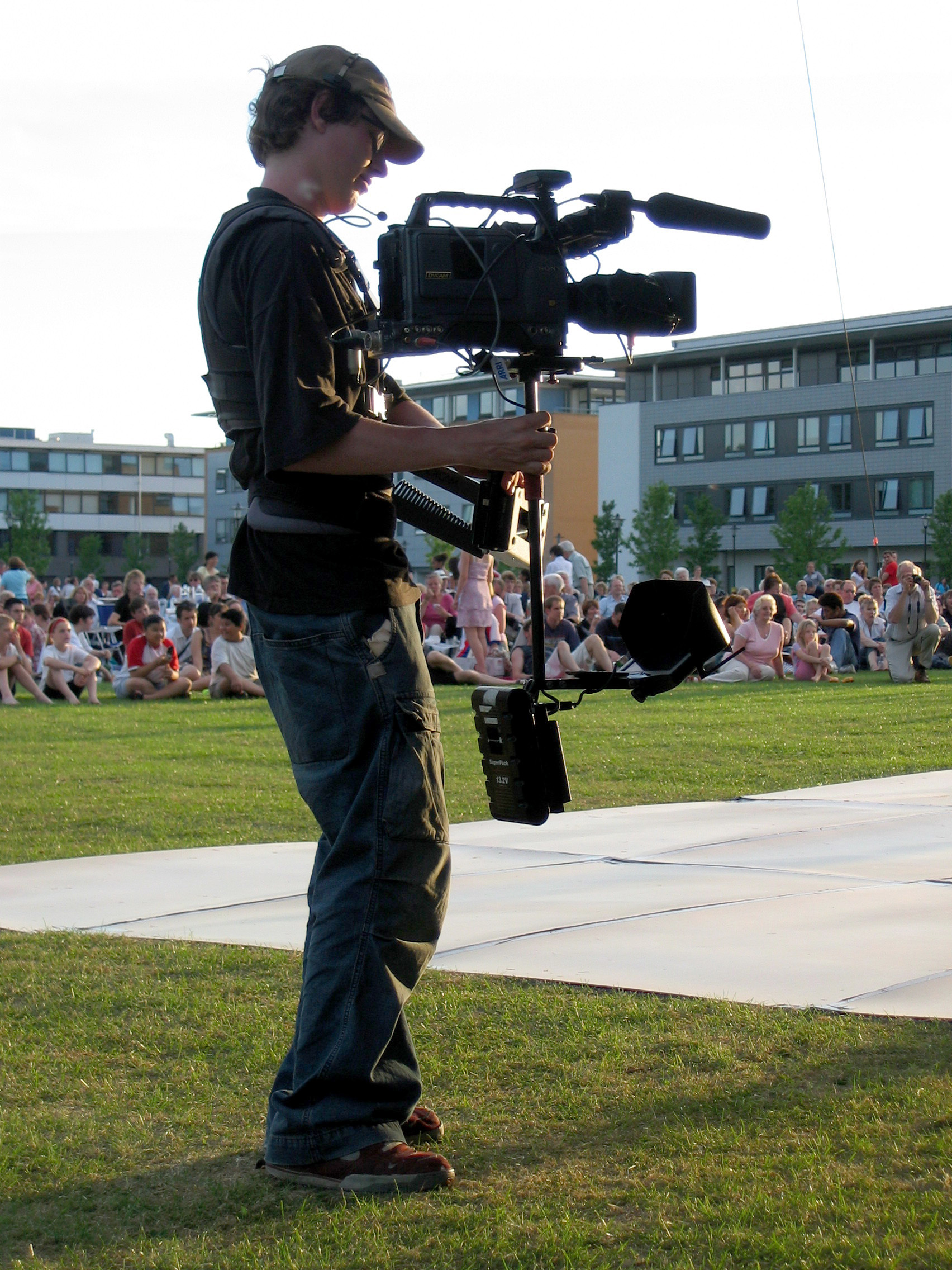
Steadicam: This is a technique which mechanically isolates the operator's movement from the camera, allowing a very smooth shot even when the operator is moving quickly over an uneven surface.

This is a popular shot that allows the camera man to get better, clearer shots, without compromising the scene, for example, in a chase scene.

Wednesday, 17 September 2008

Quick Edit

Class time fun, on film :)


Monday, 15 September 2008

How I Consume My Music.

I have been asked to write an essay to how i obtain, consume and handle my music. To put it simply, i love music. However, the bands that i love, wouldn't agree to the methods at with i obtain their product.
As many of people nowadays, i use peer-to-peer file sharing clients to get my music, such as LimeWire. Thanks to this and other forum sites i haven't bought a single track for 2 years. The last album i bought was Paolo Nutini's, These Streets.
The only reason i would buy music would be if it was a band that i knew needed my support, like Paolo Nutini. I had heard early demos and really enjoyed them, and of course when they got signed and their album came out, i decided that they where worth the £10.
I share my music through music forums and to my friends via sending them a song on msn or burning a CD for them. I try and give back to the bands as much as i can (...without buying their tracks) by going to see them in concert. Currently i have bought tickets to see 4 bands in November alone.
I believe that artists should receive money for their work but as it stands I'm torn. Torn between being a fan of the artist and a broke teen who loves music. I don't want to see my favorite bands going bankrupt because everyone is downloading their new album, but i also want to have that same new album as soon as, and in most cases before it's released, and the only way for me to get it at the moment it, is to illegally download it.
I don't believe that the musicians, managers, record labels or fans will be happy until there is a fundamental change in the way we obtain, consume and handle our music.

Saturday, 13 September 2008

High Angles, Low Angles and Canted Angles

High Angles: A high angle shows the subject from above, i.e. the camera is angled down towards the subject. This has the effect of diminishing the subject, making them appear less powerful, less significant or even submissive.
Low Angles: This shows the subject from below, giving them the impression of being more powerful or dominant.
Canted Angles: Sometimes the camera is tilted to suggest imbalance, transition and instability. This technique is used to suggest POV shots (a hand held camera is often used for this).

High Angle Picture


Low Angle Picture


Canted Angle Picture

Point of View Shots and Over the Shoulder Shot

Point of View Shot: (also known as POV shot or a subjective camera) This type of shot is used to show a view from the subject's perspective. Usually established by being positioned between a shot of a character looking at something, and a shot showing the character's reaction so the audience is aware that it is a POV shot.
Over the Shoulder Shot: This type of shot is taken from behind a person at the subject, cutting off the frame just behind the ear. The person facing the subject should occupy about 1/3 of the frame.This shot helps to establish the positions of each person, and get the feel of looking at one person from the other's point of view.

Point of View Picture

This point of view shot took place just after an establishing shot of a character "Locke" looking at the television at the video being played, which tells the audience that this is what john is currently watching. This allows the director to have the audience more engaged at what is being shown/ what the character is looking at.

Over the Shoulder Picture

This shot was used to connect the audience to the characters and the events going on around/between the characters. This shot, I felt, was used to great effect as it also showed the expressions on the characters face which may have been lost it it was taken from a medium shot.

Cheesy Rathmore Video

Dan for slideshow maker '08-'09!

Two Shots and Aerial Shots

Two Shot: This type of shot encompasses a view of two people. The subjects do not have to be next to each other, and there are many common two-shots which have one subject in the foreground and the other subject in the background. Often used in interviews, or when two presenters are hosting a show.
Aerial Shot: This is simply a shot taken from the air. Aerial shots are usually done with a crane or with a camera attached to a special helicopter to view large landscapes. Often used in car chases or used to make the character seem insignificant or vulnerable.

Two Shot Picture


As we can see from the picture above that in this particular two shot that, as the definition explained, one subject is in the foreground and the other subject in the background. This is a good shot for conversations and interactions between the characters.

Aerial Shot Picture


This is an example of another way an aerial shot can be used, compared to the examples given in the definition. This was used to give the audience a feeling of helplessness and detachment from the people on the ship, just as the characters felt when they saw this happen from the helicopter.

Tuesday, 9 September 2008

Medium Shots and Close up Shots

Medium Shot: This is a shot where the subject and background share equal dominance in the picture. A medium shot of an individual will take in the body from the knees or waist up.
Close Up: This is a shot in which the subject is tightly framed and shown at a relatively large scale i.e. a very close shot of a person or an object.

Medium Shot Picture

The Medium Shot is a good framing for conversation scenes (like the one seen above) between characters, especially if hand movements are part of the performance.

Close Up Picture

Close ups (example seen above) of characters are a good way to engaging the audience into the character emotionally, such as in this seen, when the director used this dramatic close up to show the detached feelings of Ben (character above) to the character he was in the scene to show a side of Ben's character to the audience.

Medium and Close Up Video


In this clip, the audience is immediately engaged in the character as the director uses a number of close up shots to get across the tense feeling in the room (from 0:08-0:27). Later in the video we see the director begin to use medium shots and close ups for discussion between the characters (from 0:44-1:54).

Monday, 8 September 2008

Long Shots and Extreme Long Shots

Long Shot: In film a shot taken from a distance that is used to convey a sense if space or to locate action in a specific place.
Extreme Long Shots: (aka the Wide Shot or Establishing Shot) The shot or sequence of shots in film or television that establishes a situation or location. It locates the initial meaning of th narrative.

I was asked to find evidence of both a long shot and an extreme long shot. I first had to find out what these terms ment (definitions seen above.)

I decided to take an example from my favorite show, Lost.

Long Shot Picture


This shot was used to get across to the audience the environment that the character are in and how many of the characters are effected in this scene.

Extreme Long Shot Picture


This shot was used to discover the small piece of civilization that "the others" have within a jungle that to the other main characters seems very untamed. Up until this point of the story the audience was led to believe that this scene took place off island.